Why visit the Driftless Area
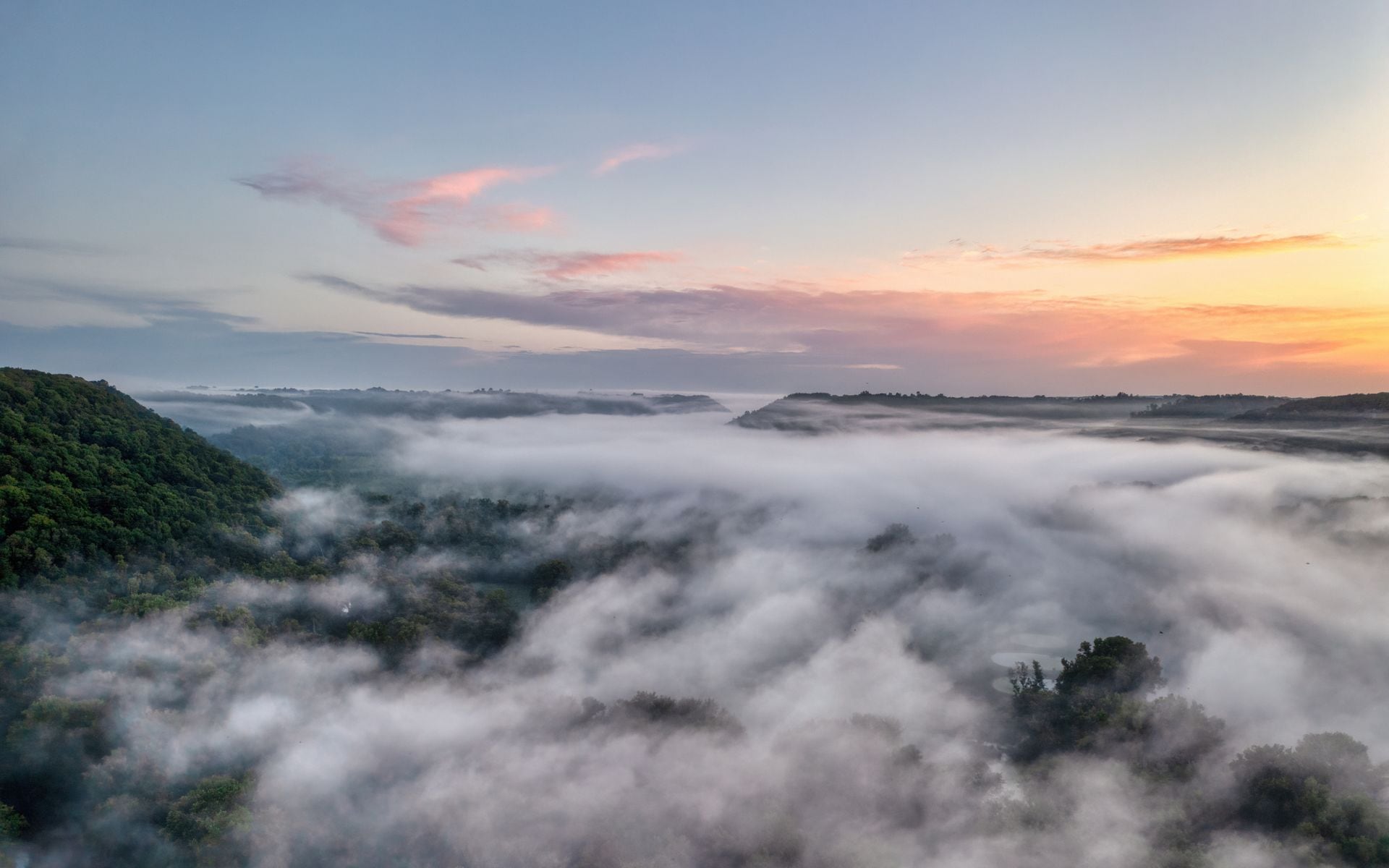
When the last ice sheets retreated about 10,000 years ago, they missed the southwest corner of Wisconsin entirely. The result is a landscape that looks nothing like the rest of the state. Ridges rise 400 to 500 feet above narrow valleys called coulees, spring-fed streams cut through dolomite and sandstone before emptying into the Mississippi, and the whole region feels older and more layered than the glaciated lake country to the north and east.
The Wisconsin Travel Guide covers seven regions, and the Driftless rewards slow travel more than any of them. State Route 35, Wisconsin's stretch of the Great River Road, runs about 250 miles along the Mississippi from Prescott near the Minnesota border south to the Illinois line, passing eagle-watching pullouts, historic ferry crossings, and riverside towns that haven't been sanded smooth by mass tourism. Inland, the Kickapoo Valley and the ridge country around Viroqua and Spring Green give the region a second dimension that most visitors only discover by returning a second time.
Top places in the Driftless Area
La Crosse anchors the region. The city of about 52,000 sits at the confluence of the Black, La Crosse, and Mississippi Rivers, and Grandad Bluff Park gives you a 1,200-foot viewpoint over three states on a clear day. To reach the overlook, drive up Bliss Road from the east side of the city and park at the lot near the top. The pullout on the south side of the road has the sharpest angle on the valley below. The downtown is compact and walkable, with Riverside Park along the Mississippi and the Pearl Street corridor a few blocks east handling most of the restaurants and nightlife.
Prairie du Chien, about 60 miles south of La Crosse on the Great River Road, is one of the oldest European-settled cities in Wisconsin. Villa Louis on St. Feriole Island is a restored 19th-century fur-trade estate open for guided tours from May through October. The annual Prairie Villa Rendezvous in late July draws hundreds of historical re-enactors to the riverside meadows and fills every motel in town, so book well ahead if you plan to attend.
Spring Green, roughly 75 miles east of La Crosse on US-14, is where Frank Lloyd Wright built Taliesin, his home and primary studio from 1911 until his death in 1959. Tours run from May through October; a 90-minute guided house tour runs around $45 to $55 per person (estimated pricing), and a four-hour estate tour covers the drafting rooms, garden, and hillside grounds in depth. The American Players Theatre sits in a wooded outdoor amphitheater just outside town and stages classical and Shakespearean productions from mid-June through mid-October, with evening performances that start as the light fades over the trees.
The Kickapoo Valley Reserve near La Farge covers more than 8,600 acres of public land along the Kickapoo River, widely known as one of the most crooked streams in North America. Outfitters in Ontario and Soldiers Grove run canoe and kayak trips on the Kickapoo's slow, winding channel through bottomland hardwood forest. Half-day float trips typically run $30 to $45 per person (estimated), and the water is calm enough for beginners.
Top things to do
Eagle watching is one of the Driftless Area's strongest draws for visitors who know to look for it. Bald eagles gather below the open water at Lock and Dam No. 7 near Onalaska from November through March, often perching on ice floes close enough to see without a spotting scope. Lock and Dam No. 9 near Lynxville pulls a similar concentration further south on the river. January and February, when the surrounding water freezes and the eagles concentrate at the one open stretch, offer the best counts.
Trout fishing in the Driftless brings serious anglers from across the upper Midwest. The Kickapoo River and its tributaries, Timber Coulee Creek near Coon Valley, and the West Fork of the Kickapoo all hold populations of wild brown trout. Wisconsin's general trout season opens the first Saturday in May; a short-term non-resident fishing license runs around $20 (estimated), and the Wisconsin DNR publishes an annual stream guide with classifications and access points.
La Crosse has a craft beer scene worth an evening. The Crow on 3rd Street South runs a rotating tap list with a kitchen that stands on its own, and Bodega Brew Pub, a few blocks away on 4th Street South, has been making its own beers on-site for years and tends to hold a crowd on weekend nights. For food, the best supper clubs in Wisconsin are well-represented in this part of the state. Buzzard Billy's on Pearl Street serves Cajun-influenced seafood, a beer cheese soup that holds up to comparison with anything in the state, and portions that reflect the city's scale. North Country Steak Buffet on Rose Street runs a fixed-price steak and sides format for around $16 to $22 per person (estimated) and fills up with locals on Friday nights, which is usually the clearest signal that the food is genuine.
Where to stay
The Charmant Hotel in downtown La Crosse is the region's most distinct property. Sixty-one rooms occupy a restored 1920s candy factory on State Street, with art deco details throughout and an attached restaurant that sources locally. Rates run roughly $150 to $250 per night depending on season, and the hotel books out on fall-color and summer festival weekends. Chain properties in La Crosse start around $80 to $110 per night and are concentrated near the interchange of US-14 and I-90.
Along the Great River Road south of La Crosse, Prairie du Chien and Viroqua both have limited lodging, so event weekends require advance planning. Spring Green has a small set of inns, vacation rentals, and one larger resort property that fills during Taliesin tour season and American Players Theatre weekends. For the full picture of where to stay across the state, Where to Stay in Wisconsin lays out options by region and price tier.
Getting there and around
La Crosse Regional Airport (LSE) has connecting service through Minneapolis-St. Paul (MSP), which sits about 2.5 hours to the northwest by car. Most visitors drive: La Crosse is about 3 hours northwest of Madison on I-90/94, roughly 3.5 hours from Milwaukee, and about 4 hours from Chicago O'Hare (ORD) via I-90 across southern Wisconsin. Amtrak's Empire Builder stops in La Crosse on the Chicago to Seattle route, which makes it one of the few Driftless destinations reachable without a car at the starting point, though you will need a rental once you arrive.
A car is essential for exploring the interior coulees and the Kickapoo Valley. State Route 35 is the main road for the Great River Road stretch, but reaching the ridge-top overlooks, the Kickapoo outfitters, and the Spring Green area means county roads that wind and climb steeply. The Great River Road Guide covers the full 250-mile Wisconsin routing with recommended stops and approximate drive times between them.
Best time to visit
Late May through mid-October is the main window. Summer (June through August) brings full Kickapoo River paddling conditions, warm evenings at the outdoor American Players Theatre and Taliesin, and La Crosse's summer festival circuit, including the La Crosse Interstate Fair in mid-August. The water temperature in the river is warm enough for comfortable paddling from June onward.
Fall is the strongest reason many people make the trip. The coulee ridgelines and river bluffs turn gold, orange, and red from late September into mid-October, and this part of Wisconsin tends to draw fewer fall-color visitors than Door County even though the ridge-and-valley scenery is comparable in its own way. Eagle watching peaks from November through February, with January and February offering the densest congregations. Winter driving on the steep county roads in the bluffs requires care; check road conditions before heading into the interior. Spring brings trout season in May, redbud and dogwood blooming in the river valleys by late April, and noticeably thinner crowds than summer at every major stop along the route.
Frequently asked questions
What makes the Driftless Area different from the rest of Wisconsin?
The Driftless Area was not covered by the glaciers that shaped most of the upper Midwest. Instead of the flat terrain, moraines, and kettle lakes found across northern and central Wisconsin, the Driftless has deep river coulees, steep ridges, exposed bedrock, and spring-fed streams that cut through valleys over millions of years without any glacial reshaping. The result is a more varied, vertically dramatic landscape, which is why the trout streams here are cold and fast and why the bluff views over the Mississippi are so sharp.
What is the best town to base yourself in for a Driftless Area trip?
La Crosse is the most practical base. It has the widest selection of hotels and restaurants, it sits in the middle of the Great River Road's Wisconsin stretch, and it's about an hour from both Prairie du Chien to the south and Spring Green to the east on US-14. If your main interest is Taliesin and the Spring Green area, staying in Spring Green or the nearby town of Dodgeville cuts the driving. For Kickapoo Valley paddling, the towns of Ontario and Viola are closer but have very limited lodging options.
When is the best time to see eagles on the Great River Road?
January and February are the peak months. Bald eagles concentrate below the open tailwater at Lock and Dam No. 7 near Onalaska and Lock and Dam No. 9 near Lynxville when the surrounding river freezes, leaving only those stretches of open water for fishing. You can usually see dozens of birds from the river road without binoculars. The Wisconsin Department of Natural Resources runs organized eagle-watching events in the La Crosse area in late January most years.
How long does it take to drive the Great River Road through Wisconsin?
The full Wisconsin stretch of the Great River Road runs about 250 miles along State Route 35 from Prescott in the north to the Illinois border near Hazel Green in the south. Driving it straight through without stops takes roughly four to five hours, but stopping at the overlooks, walking through Prairie du Chien, taking a river ferry, and eating lunch in La Crosse stretches it to a full day or more. Most people drive it as part of a two-to-three day loop combined with the Kickapoo Valley or Spring Green.